
Knowledge Hub
Payroll Outsourcing Buyer's Guide
Choosing a new payroll service isn’t easy. And switching providers isn’t either. We’ve pulled together all the insights you need to help you make an informed decision when considering payroll outsourcing. No matter your organisation’s size or sector, this guide helps you choose the right provider for the long-term.
Download your copy

Contents
Jump straight to the section you’re interested in by using the navigation below, or just get scrolling to start from the beginning.
Understand what payroll outsourcing is—and why it might be the best solution.
The benefits of payroll outsourcing
Learn about the benefits an outsourced provider can bring your business.
The different types of outsourcing
Find out the difference between fully-managed, part-service, & bureau providers.
What a provider will need to know
Understand what potential providers will need to know.
What to look for in a provider
Do you know what to look for in your market research? We cover the basics.
Looking beyond the basic functionality, here's other features to consider.
Understand what you need to ask in the sourcing process.
Find out why Cintra should be your next outsourced software provider.
What is payroll outsourcing?
Payroll is a crucial part of any business operation. If cashflow is the lifeblood of an organisation, payroll is how it gets to the vital organs. And the bigger the organisation, the bigger the task of getting the right sums to the right people, right on time. Every time.
It’s one thing managing payroll for a small business, it’s quite another when you have multiple departments to manage—especially with a range of different contracts and with a variety of deductions for tax, pensions, student loans and more. So, the desire for someone to step in and lend a hand is a very real one for smaller businesses.
Even in larger organisations where there might be a dedicated payroll team at hand, you might still prefer to tender out your payroll function.
The one constant, no matter your organisation’s size, is that payroll is essential. No matter how you choose to go about it.
And as over 52% (CIPD) of companies now outsource payroll, and the figure expected to exceed 60% (CIPP) by the end of 2025, it’s worth considering if it could be the right decision for you.
There are a variety of third-party companies in the market, all with a range of solutions to help businesses streamline tasks such as processing payroll, filing taxes, calculating and applying deductions.
Often, they also look after reporting regarding new hires, and other critical accounting-related tasks. Payroll providers can also handle benefits deductions and benefit administration for employees. Some even integrate with HR to take on wider related functions.
But to be able to distinguish the good providers from the great, you need to understand the benefits.
Get the latest insights and best practice guides, direct to your inbox.
The benefits of outsourcing your payroll
Payroll should be one of the strongest frameworks behind your business as without it, you’ll never get a true snapshot of your finances or your people. And, with outsourcing, you utilise four key elements in making the process run smoothly:
Time
UC assessments rely on RTI submissions. This means any errors in pay amounts, payment dates, or submission timing can directly impact an employee’s UC award. Responsibility for accurate reporting sits with you.
Cost
Problems most often arise from late FPS submissions, incorrect payment dates, duplicate or re-run payrolls, or reporting payments that were later corrected or reversed. Even small inaccuracies can affect UC calculations for that assessment period.
Efficiency
Incorrect or late RTI data can result in UC underpayments or overpayments, often causing financial strain. Where this happens, employees may need to challenge their UC award—but these disputes usually can’t be resolved until the employer corrects the RTI submission.
Expertise
If RTI data affects an employee’s UC, employers should first review the relevant FPS and submit a corrected FPS where necessary. Resolving the RTI issue promptly helps the DWP reassess the UC award more quickly.
Types of payroll outsourcing
Error codes vary by software and HMRC service—these are some of the most common and how to fix them:
A fully-managed service (or outsourced payroll) is one that handles your entire payroll service from beginning to end. Organisations without their own internal finance, HR, or payroll teams will obviously benefit from this. But even if you have these departments, outsourcing your payroll can give your teams the time and resources to focus on other, more business-critical activities. Full-service providers will have all the payroll expertise you could ever need, no matter your complexity or needs. They’ll take care of paying your employees on time and managing all other aspects of payroll, like one-off payments and deductions, such as tax, NI, and pensions.
If you still want to employ your own payroll employees, set their hours, and oversee the payroll process, a part-service solution can be a good option for you. Instead of handling the process from the start, they will take on specific areas, such as providing payslips or processing BACS. This is a great option if it’s important to you to retain some control over payroll. As with fully-managed payroll services, though, a part-service provider or bureau should also bring expertise in terms of legislation, regulations, and other compliance issues.
A payroll bureau is an external service provider that manages payroll services on behalf of businesses. Traditionally, this was like a part-managed service, in that you would retain an in-house payroll function but supplement it with services provided by the bureau. But now, a payroll bureau is often the same as a full part-managed service. So, it’s important to understand exactly what each prospective payroll provider does and doesn’t offer before you decide if it’s right for you.
What a payroll service provider will need to know
When considering payroll outsourcing, it’s not just about finding the right fit for you. It’s a mutual relationship between you and your future provider—so it needs to be the right choice for them too. Here’s what a professional payroll service provider will typically need to know about your organisation, and what you should look for to make sure you’re finding the right expertise for your sector:
Key information providers will request:
Business structure and size: Providers often specialise by business size or location, so they need to know how many people you employ, the types of employees (full-time, part-time, seasonal, or international), where you operate, and your entity type (limited company, charity, trust, or other).
Industry-specific requirements: Not all providers tailor to every sector, so it’s important to share any sector-specific regulations, pay structures, or reporting obligations you’ll need if you’re in industries like education or healthcare.
Current payroll processes: You’ll need to provide details of your existing payroll system and the frequency of your pay runs. It’s also in your best interest to share any pain points or inefficiencies so that they can be addressed.
Benefits and deductions: As your provider may handle this for you, you need to share information on the different pension schemes, benefits, salary sacrifice arrangements, and statutory deductions that apply to your teams.
Compliance needs: Any provider will be well-versed in every area of compliance, from GDPR and HMRC requirements to industry-specific accreditations. If you have any particular compliance challenges, it’s best to share them early.
Integration requirements: For many, payroll is not just financial processing; it’s part of your bigger people management process, connecting to HR and finance systems. If you have any current integrations—or if you’re looking to integrate your systems—your provider will need to know to assess if they are the right fit for you.
Reporting and analytics: It’s all fine and well, processing your payroll. You also need to be able to report on it. To make sure you get the reports you need, whether it be for management, statutory, or audit purposes, share anything you might require to make sure they can meet your needs.
Support expectations: Support is a big part of the outsourcing process; after all, you need to be able to trust that your provider will be there if things go wrong. To make sure they can meet your needs, be sure to ask providers if they can accommodate preferred communication channels, SLAs, and escalation procedures.
Fully managed payroll services you can trust
With Cintra, you gain access to a team of qualified payroll specialists who guarantee accuracy, compliance and timely delivery, every time. Find out more about our outsourced payroll service, including the incredible technology we’ve invested over £10m into in the last three years.
Download your payroll software brochure

What to look for in an outsourced payroll provider
Payroll processing
First things first, no matter how great the other features your provider may offer, there’s one obvious priority to look for. That your people get paid on time and accurately. And if you’re looking for a fully managed service, it’s the biggest one. Whether it’s weekly, fortnightly, or monthly, your provider needs to be able to calculate the exact amount every employee is due, taking into account wage rates, shift differentials, overtime, holiday pay, tax, and any other deductions. These calculations will be automated, so it’s important to make sure their software is reliable—their accuracy rate will be a big tell for this!
They will also take responsibility for making sure the payments make it to your employees’ bank accounts using BACS as the industry standard.
Year-end reporting
Employers must submit their final payroll reports to HMRC in time for Tax Year End on 5 April, and update employee payroll records in preparation for the new tax year starting on 6 April, including issuing employees with a P60 by 31st May.
RTI reporting
Real-time online reporting of who is paid what for tax purposes is a legal requirement. Your provider should have systems in place for generating and submitting Full Payment Submission (FPS) and Employer Payment Summary (EPS). HMRC must be informed whenever employees are paid, whether that’s weekly, monthly, or quarterly; with real-time reporting, there’s full visibility of every payment.
They will also take responsibility for making sure the payments make it to your employees’ bank accounts using BACS as the industry standard.
Tax calculations
Only payrollers could truly understand just how complex calculating tax can be. Thanks to payroll software, it’s an automated task, and it will be for your provider, too. This means that calculations are done in real time with minimal scope for mistakes, thanks to things like variance analysis and error flagging. But, with outsourcing, double and triple checking for errors is your payroll provider’s responsibility.
Holiday & absence management
A good payroll provider will also provide functionality to manage your employees’ holidays and sick days, logging time off and any deductions as a result. This is typically done through an employee self-service platform that they provide, where employees can request their holidays, absence, and more, which syncs to their payroll system automatically. This saves time for your HR team—and your provider’s—while giving employees a greater sense of control over their own payroll experience. Think of it as ‘outsourcing’ certain functions back to your employees.
They will also take responsibility for making sure the payments make it to your employees’ bank accounts using BACS as the industry standard.
General reporting
In addition to generating HMRC-required statutory reports, your payroll provider should generate payroll analytics. This could be anything from insights into absences that should be on your radar or other trends, as well as generating reports on pay variance, pension details, and more—all of which is especially useful for demonstrating compliance. The best software will also be able to create custom reports for whatever data you need, so your provider should be able to do that on request. It’s your data, after all.
Payslip generation
Payslips, P45s, and P60s should be generated as part of the process, and a good provider will make sure they are all 100% compliant. These are then delivered to your employees electronically and stored for access when needed.
They will also take responsibility for making sure the payments make it to your employees’ bank accounts using BACS as the industry standard.
Cloud portal
The bare minimum you can expect from your payroll provider is full visibility of your payroll; and a cloud-based portal is the most straightforward way to do this. If a provider doesn’t have their own—or is using someone else’s system—they simply aren’t a future-forward option. Nearly everything on our lives is on the cloud, or digital in some way, so it makes sense for your payroll to be too. Not only does it make data submission secure, it gives you access to payroll documents or live reporting wherever you are.
Additional services to look out for
Your provider can also make the necessary payments to your pension provider. This means assessing which employees are eligible for automatic enrolment in your workplace pension scheme and calculating the deductions involved. A good payroll provider will be able to manage multiple different pension types and even apply different structures to one employee.
Liabilities cover any tax, employer and employee National Insurance, and apprenticeship levy that an organisation owes HMRC. It’s another piece of HMRC compliance to keep track of, so many providers offer payment of liability services to help keep you compliant and up to speed on your payments. Employers can also be required to make ‘attachment of earnings’ payments if an employee has been fined by a court. So, that’s covered too.
As the payrolling on benefits in kind (BIKs) is becoming mandatory, it’s important that your payroll provider is equipped to manage this on your behalf. That means things like company cars, private health insurance, childcare or travel costs all must be reported and taxed through payroll, rather than submitting the traditional P11D or P11D(b) forms.
Employers with workplace pension schemes are responsible for reporting regularly to HMRC, including submitting the pension scheme returns and event reports. Your payroll provider should be able to do all this on your behalf.
There are a couple of standard options when it comes to actually paying your employees. Some providers will produce a payment file compatible with the organisation’s bank, so you can upload that in one go without having to key in the amounts for each employee. More likely—as mentioned above—they will pay by BACS. This means payments are sent directly into employees’ bank accounts with no fuss and no mistakes—software depending!
Important considerations for outsourcing payroll
There’s so much more to consider beyond the basic services offered.
When you outsource your payroll, you are sharing incredibly sensitive information about your business and every person you employ. In almost all instances, this will be via a cloud-based database, so cyber protection and data security aren’t something you can afford to compromise on when choosing a provider.
All companies are required to be GDPR compliant, so it’s not something you have to actively search for in your next provider. What this means is things like consolidating personnel and payroll data or making sure sick notes and timesheets are accounted for and not spread in too many different places, whether on paper or virtually. There are severe penalties for violations, and it can severely impact trust if employee data falls into the wrong hands, so it’s important to get this right.
In addition to GDPR, there are a number of other standards to bear in mind. A good payroll provider will be able to reassure you that they tick all the following boxes.
- GDPR
- CIPP Payroll Assurance Scheme
- HMRC recognised
- ISO2007 and ISO9001
- BACS approved bureau
- Automatic enrolment
Payroll is an intimate business, involving sensitive information—not to mention large sums of money—so you should expect a close working relationship with your provider, with plenty of communication in both directions. Your provider should also be in touch to let you know about any major software updates and explain what they might mean for you. From better providers, you can expect access to a dedicated support team who understand not only payroll but how your team operates. You’ll also have a payroll manager, a dedicated point of contact who is on-hand to deal with any queries you may have.
A good way to ensure both parties are on the same page is to get service-level in place from the beginning of the relationship. These should set out which party is responsible for doing what and when, so nothing is duplicated or falls through the cracks, and expectations are managed early. It goes without saying that clear channels of communication should be in place, too. This includes regular meetings and reviews to make sure everything is running smoothly.
Data and payroll go hand-in-hand, so your provider needs to eat, sleep, and dream data. Their system will store all your people’s information, from their name, address, and National Insurance number to their student loan status and any other deductions that apply to their pay. This should be fully integrated with your own systems too, so any changes made via employee self-service are automatically registered on both sides.
On that note, many providers offer packages that fully integrate payroll with other HR functions for a single source of people management. This could stem from holiday and absence management features to onboarding, time management, and employee engagement capabilities. At a very basic level, when you enter a new employee’s personal data into your HR system, they can be added automatically to payroll, saving you from duplicating what’s essentially the same job. It also makes sense to have data to do with pensions, benefits, expenses, and even recruitment accessible from both directions.
As an employer, you can’t outsource the responsibility of compliance. But with the right provider, you can ease the burden significantly. They make it their business to keep up with changing legislation and regulations, including GDPR, as well as the various requirements set out by HMRC. And they will ensure the reports they generate on your behalf are fully compliant, whether that’s your Full Payment Submission (FPS), Employer Payment Summary (EPS), or Payroll Year End. Your provider should also be able to generate an annual report on your organisation’s gender pay gap or expenses and benefits (P11Ds)—another legal requirement.
HMRC maintains a payroll software directory that highlights all platforms that are fully compliant, so checking if your provider’s software makes the list is a smart move.
Finally, the factor that most decisions will depend upon. The price. Unfortunately, there’s no definitive answer as to how much it will cost to outsource your payroll. It all depends on a variety of factors like the size and complexity of your organisation. Don’t forget that the right provider will save you money in the long term, by freeing up your own staff (and preventing expensive mistakes), so the cheapest option won’t necessarily be the most economical in the long term.
In most cases, you should expect to pay your payroll provider monthly—just as they probably pay your employees—often based on a given sum per employee. Some providers will also charge a certain amount upfront for implementation, so make sure you are clear on total costs to avoid ‘hidden fees’. It’s best to get a several quotes and ask as many questions as possible; after all you need to be confident that it’s the best value for money.
Questions to ask potential providers
Your payroll provider will become an extension of your company, so it’s important to have a mutual understanding from the sourcing process.
You should enter the sourcing process much like you would when you’re interviewing a potential new hire. There should be an open, detailed dialogue that fills you with confidence that they are the right provider for you. It’s the time to ask questions—yes, be incessant—and expect carefully considered answers that indicate your prospective provider is serious about understanding your needs. If they don’t fully understand your processes, they can’t tailor their service to meet them.
Here are some questions to get you started. In most cases, the correct answers are obvious! Still, even if a contender is unable to ‘tick all the boxes’, you should hear them out if they have a plausible explanation for falling short on this or that count. It’s the overall package that really counts, and—crucially— the sense that this is an organisation on the right wavelength, and with which you can imagine having a productive long-term relationship.
Can you provide references from customers in my industry?
What security measures do you have in place to protect sensitive payroll data and ensure compliance with GDPR and UK data protection?
Can you meet my industry’s specific requirements when it comes to reporting and compliance variations?
What is the process for transferring our payroll data to your system?
What are your SLAs for payroll delivery and issue resolution?
How do you handle confidential employee inquiries?
How do you handle data migration to maintain data accuracy during the transition?
How do you guarantee compliance with UK payroll regulations?
What services are included in your standard payroll offering and what will come at an extra cost?
Can you accommodate any unique requirements, or specific payroll processes our organisation may have?
How do you maintain the accuracy and timeliness of payroll processing?
Why choose Cintra?
No matter how complex your payroll needs, Cintra has every feature you could need—now and in the future.
Accurate, reliable, scalable
With an average user accuracy rate of 99.99%, you can count on our features to keep your paydays accurate, every single time. No matter how you grow, we're here to keep everything running smoothly.
Deep functionality
We're one of the most advanced in-house payroll software solutions on the market; with the greatest depth of features, you can get from a single platform. It’s truly best of the best.
Holistic support
Our support team aren’t just real people, but real payrollers. And, they are on hand whenever you need us—yes, really. We answer 90% of calls first time and return 100% within 2 hours.
Advanced security
You shouldn’t have to worry about the security of your data—and with Cintra, you don’t have to. We invest £500,000 in cybersecurity every single year, so we’re ahead of the curve.
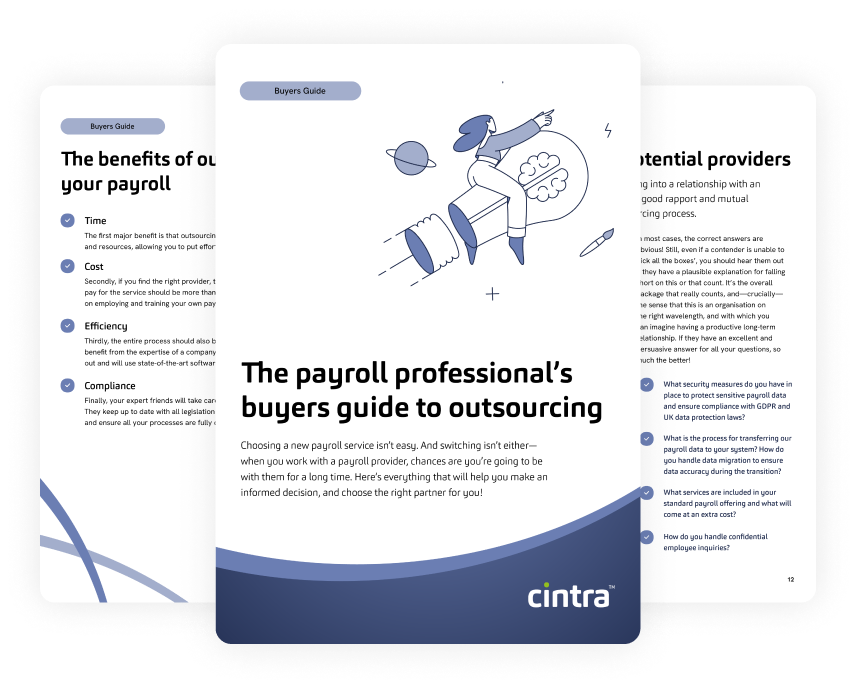
Payroll Outsourcing Buyers Guide
We cover everything you need to consider in your buyers journey when choosing a new payroll outsourcing partner, including core service types, top considerations, additional services to look out for and more!