Knowledge Hub
Gender Pay Gap Reporting Your Complete UK Guide
Your complete guide to gender pay gap reporting: from what it is, who and what you must report, narratives, action plans, and reducing your pay gap

If you’re responsible for a UK organisation with 250 or more employees, gender pay gap reporting is something you need to get right. It’s a legal requirement; missing the deadline can result in fines and a public late badge on the government reporting service.
Done properly, gender pay gap reporting is a chance to understand your organisation better, spot pay disparities you might have missed, and take the necessary steps to get toward fairer pay practices.
And, there’s numbers to prove it’s possible. The latest figures from The Insolvency Service demonstrated that the mean gender pay gap dropped from 8.7% in 2023 to just 4.6% in 2025, with the median gap down from 11.1% to 3.0%. Even more encouraging—their bonus gap now shows women receiving slightly higher average bonuses than men.
So, whether you’re preparing your first report or looking to improve your numbers, this guide will walk you through everything you need to know.
What is the gender pay gap?
The gender pay gap refers to the difference in average pay between men and women across your entire workforce. It’s usually expressed as a percentage of men’s earnings.
For example, if men in your organisation earn £40 per hour on average and women earn £36, your gap would be 10%.
THE GENDER PAY GAP FORMULA
(Men’s average pay − Women’s average pay ) ÷ Men’s average pay × 100
⚠️ Important distinction
The gap doesn’t necessarily mean you’re paying women less than men for doing the same job—that would be unequal pay, which is illegal under the Equality Act 2010. The gender pay gap reflects broader structural patterns across your organisation.
Common drivers of the gender pay gap include:
- Representation in senior roles: Men often hold a higher proportion of senior, higher-paying positions.
- Part-time work: Women are more likely to work part-time, which can affect average hourly rates.
- Career breaks: Women are 12 times more likely to take time out for caregiving, impacting progression.
- Industry or department concentration: Certain roles may be dominated by one gender and paid differently.
Think of it this way—if all your senior leadership roles are held by men and most of your administrative roles are held by women, you’ll have a gender pay gap—even if everyone’s being paid fairly for their specific role.
Gender pay gap vs equal pay: what's the legal difference?
While both are fundamental to equality in the workplace, gender pay gap and equal pay gap reporting are not the same thing.
- Employers in scope must calculate the prescribed measures using the statutory definitions of pay, bonus pay and relevant employees.
- Employers must publish the results in the required format, on time and in a publicly accessible way, and submit them to the government reporting service.
- For most private and voluntary sector employers, a written statement signed by an appropriate senior person is required to confirm the accuracy of the published figures. A narrative and action plan are not mandated by the regulations (although commonly used).
Gender pay gap
The difference in average earnings between men and women across an organisation, reflecting the structural differences in the workforce.
Equal pay (legal right)
The legal requirement that men and women performing equal work receive equal pay. Failing this is unlawful under the Equality Act 2010.
The difference is vital in working towards a fair and inclusive workplace. Equal pay law has more than just an individual impact, it affects how employees, clients, and the wider market see your brand.
What is gender pay gap reporting?
Gender pay gap reporting is a legal requirement that was introduced in the UK in 2017. It requires larger employers to publish specific data about the pay differences between male and female employees, making transparency a legal necessity.
By making this information public, the government aims to shine a light on pay inequalities and encourage organisations to actually do something about them.
What the law requires
- Employers in scope must calculate the prescribed measures using the statutory definitions of pay, bonus pay and relevant employees.
- Employers must publish the results in the required format, on time and in a publicly accessible way, and submit them to the government reporting service.
- For most private and voluntary sector employers, a written statement signed by an appropriate senior person is required to confirm the accuracy of the published figures. A narrative and action plan are not mandated by the regulations (although commonly used).
What you must decide
- Decide who owns the reporting process internally: HR, reward, payroll, finance, legal, or a joint effort.
- Decide how to define and quality-check the underlying payroll dataset and employee data for reporting purposes (especially where you have different worker populations, variable pay, allowances or complex bonus arrangements).
- Decide the level of disclosure beyond the legal minimum (for example, whether to publish a narrative, action plan and additional breakdowns) and who signs this off.
What happens if you get it wrong?
- Late or incorrect reporting can trigger regulatory engagement and enforcement, reputational damage and commercial fallout (particularly in recruitment, procurement, and employee relations).
- Poor-quality reporting can create avoidable equal pay risk if the organisation uses the wrong language, makes casual admissions, or publishes commentary that suggests unlawful pay practices when the actual issue is structural representation.
If you employ 250 or more employees, you must publish your gender pay gap data every year. This applies across the board — private sector, public sector, charities, and voluntary organisations. If you have fewer than 250 employees, you are not legally required to report, but many choose to do so voluntarily to demonstrate commitment to pay equality.
Working out your headcount
Not sure if you’ve hit that 250 threshold? It’s not always straightforward, especially if your workforce includes various contract types.
Here’s what you need to include in your total headcount:
- All employees with a contract of employment: This includes part-time workers, job-sharers, and people on leave (maternity, paternity, sick leave, etc.).
- Partners on a salary: If you’re a partnership and your partners receive a salary, they need to be included.
- Members of a limited liability partnership (LLP): But only if they’re treated as employees for payroll purposes.
⚠️Who to exclude from gender pay gap reporting
Self-employed contractors, agency workers not paid through your payroll, partners not treated as employees, and employees on reduced or zero pay during the snapshot period should all be excluded from hourly pay calculations. Overtime payments are also excluded. Getting this wrong can distort your figures significantly.
What information must be included in your gender pay gap report?
Your gender pay gap report needs to include six specific pieces of information. This includes:
| Metric | What it measures |
|---|---|
| Mean gender pay gap | The difference between the average hourly pay of male and female employees |
| Median gender pay gap | The difference between the middle hourly pay rates when all employees are ranked lowest to highest |
| Mean bonus gender pay gap | The difference in average bonus pay between men and women |
| Proportion receiving a bonus | The percentage of male and female employees who receive a bonus |
| Pay quartiles | The percentage of men and women in each quarter of your pay distribution (lowest, lower middle, upper middle, highest) |
Calculate ordinary hourly pay
For each relevant employee, calculate their hourly rate for the snapshot pay period. Include basic pay, paid leave, shift premiums, and certain allowances. Exclude overtime, redundancy, expenses, benefits in kind, or salary sacrifice benefits.
Separate employees by gender
Split employees into male and female groups based on payroll data. Gender pay gap reporting currently operates on a binary basis as defined in the legislation.
Calculate the mean and median pay gaps
For the mean: add all hourly rates for men, divide by the number, repeat for women, then apply the formula. For the median: rank each gender from lowest to highest and find the middle value, then apply the same formula.
Calculate pay quartiles
Rank all relevant employees from lowest to highest hourly pay, split into four equal groups, then calculate the percentage of men and women in each quartile. This reveals representation patterns—whether one gender is concentrated in higher or lower pay bands.
Calculate bonus pay gaps
Bonus calculations look at the 12 months leading up to the snapshot date. Include annual bonuses, commission, profit-sharing, and long-term incentive payments. Exclude ordinary salaries and overtime.
Worked example: calculating the gender pay gap
Let’s simplify this with an example.
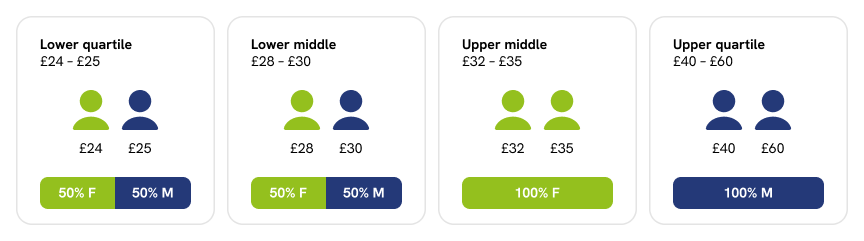
Imagine you have eight employees, four male who earn £25, £30, £40, and £60 per hour and four female who make £24, £28, £32, and £35 per hour.

All 8 employees ranked from lowest to highest hourly pay. Each person icon shows their pay rate.
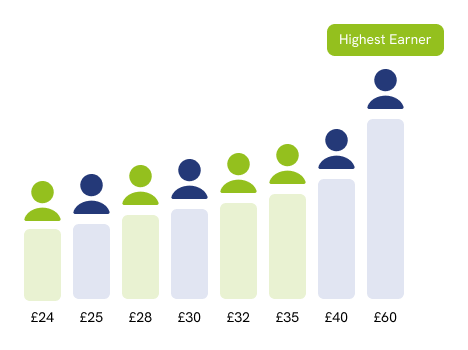
Notice how the single £60 earner stands out—this will skew the mean significantly but won’t affect the median. Switch to the next tabs to see why this matters.
The mean adds all salaries together and divides by the number of people. The single high earner pulls the male mean up sharply.
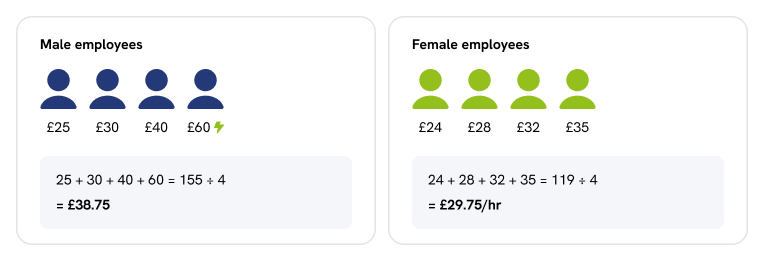
The median is the middle value when everyone is ranked. It ignores extremes—so the £60 outlier has no effect here.
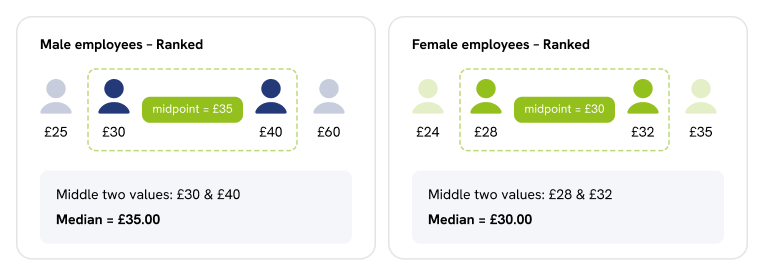
All 8 employees split into 4 equal groups (2 per quartile) from lowest to highest pay. This reveals whether one gender is concentrated at the top or bottom.
Get the latest insights and best practice guides, direct to your inbox.
When do you need to publish your gender pay gap report?
You must calculate your gender pay gap based on a specific snapshot date; this date will differ depending on your organisation. After the snapshot date, you then have 12 months to publish your report.
31 March
Public authority employers (schools, NHS bodies, government departments)
5 April
For private sector, voluntary sector, and all other public authority employers
If your snapshot date is 5 April 2026, you need to publish your report by 4 April 2027. While that might feel like a long time, gathering the data, analysing it, and writing a meaningful narrative takes time—especially if it’s your first time doing this.
Tip: Have you noticed patterns in your pay data throughout the year that might affect your snapshot? It’s worth keeping an eye on this regularly rather than scrambling at the last minute.
How to publish a gender pay gap report
You need to do two things with your gender pay gap report—share it publicly and submit it to the government. If you’re using Cintra payroll software, this process is already built in.
Publish on your website
Your report needs to be easily accessible on your company website.
A lot of organisations create a dedicated page or include it in their diversity and inclusion section. You might even choose to write a supporting statement explaining your figures and what you’re doing to improve them; this isn’t required, but it’s good practice.
Submit to the government
You also need to upload your data to the Gender Pay Gap Reporting Service, which is managed by the EHRC.
If this is your first time reporting, you’ll need to register your organisation and create an account. It’s pretty straightforward—just have your organisation details and your data ready.
⚠️What happens if you don't report?
Missing the deadline isn’t something to take lightly. Here’s what could happen:
- Legal consequences: The EHRC can take enforcement action against you. This might include legal proceedings, court orders, and ultimately fines.
- Reputational damage: Your organisation will get a late badge on the gender pay gap reporting service, visible to the public, job candidates, and customers—and that can impact trust.
Beyond the legal stuff, there’s the broader impact on your brand. In a competitive job market, failing to report (or reporting a large gap without explanation) can make it harder to attract talent and keep the people you already have.
Director sign-off and compliance requirements
In the UK, gender pay gap reports must be signed off by an appropriate senior person—specifically a director or the equivalent in your business and cannot be delegated to HR or payroll. Depending on your organisation type, the signatory should be:
| Organisation type | Required signatory |
|---|---|
| Companies | A director |
| LLPs | A partner |
| Public sector bodies | Chief executive or equivalent |
| Charities & voluntary organisations | Trustee or equivalent senior role |
The signatory must provide a written statement confirming that the gender pay gap information published is accurate to the best of their knowledge and belief. This is a legal declaration—signing off on inaccurate data carries both reputational and legal risk for the individual and the organisation.
💡 Why this matters
Director sign-off exists to embed accountability at board level. It signals that gender pay gap reporting isn’t an administrative tick-box exercise, but a matter of senior leadership responsibility. Organisations that treat it as such—with proper governance and board visibility—are also better placed to take meaningful action on the underlying gap.
Building an internal compliance process
Data extraction & validation
Pull pay and bonus data using the correct snapshot date. Validate headcount, pay elements included, and worker classifications against the legal definitions.
Calculation & sense checking
Run the six mandatory calculations and cross-check against previous years. Significant unexplained changes should be investigated before the report is finalised.
Legal review
Your legal team or external advisors should review both the data and the accompanying narrative before submission. This is particularly important if your gap has widened or if your figures are likely to attract scrutiny.
Board or leadership review
Present the findings to your board or equivalent leadership body. This is an opportunity to discuss the figures in context and agree the narrative that will accompany the report.
Director sign-off
The named director or equivalent provides the written statement and formally approves publication.
Publication & submission
Publish on your company website and submit to the government reporting portal before your deadline.
🏛️ Enforcement
Enforcement of gender pay gap reporting sits with the Equality and Human Rights Commission (EHRC). The EHRC has the power to investigate non-compliant organisations and pursue court orders requiring compliance. While formal enforcement action has historically been limited, this is an area of increasing scrutiny—and the reputational consequences of failing to report, or reporting inaccurately, are something any business should avoid.
Employees, investors, and the media routinely monitor gender pay gap data. Organisations that fail to report, report late, or publish figures that appear inconsistent with their workforce face serious reputational risk that enforcement action alone doesn’t capture.
How to write a gender pay gap narrative & action plan
Organisations that publish only the bare minimum data, with no explanation or action plan, often face greater scrutiny than those whose gap is larger, but who communicate openly about it. The narrative is your opportunity to show the story behind the numbers and build trust with your stakeholder, and an action plan is where you demonstrate what you’re actually doing about it. Together, they’re your opportunity to show employees, candidates, and stakeholders that your organisation takes this seriously.
Is a narrative legally required?
No—a narrative and action plan are not legally required for most private and voluntary sector employers. But the absence of one is noticed, particularly if your gap has widened year-on-year or sits significantly above your sector average.
What to include in your narrative
A strong narrative typically covers four things:
Context for your figures
This is an opportunity to explain what’s driving your numbers, so avoid just restating them. Is your gap primarily a representation issue at senior levels? Do you have a large proportion of part-time roles concentrated in one gender? Are there particular business units or functions creating a skew? The more specific and honest you are, the more credible your narrative becomes.
Year-on-year comparison
If your gap has improved, say so and explain what contributed to it. If it has widened, acknowledge it and explain why—whether that’s a structural change, an acquisition, or a recruitment spike in a particular area. Attempting to obscure a worsening gap rarely works and tends to invite more scrutiny.
What you’ve already done
This is where you document actions taken in the previous reporting period. Be specific rather than vague—”we introduced structured interview panels” is more credible than “we are committed to inclusive hiring”.
What you’re planning to do
Lead into your action plan here. This creates a natural bridge between your narrative and the commitments you’re making for the year ahead.
What to include in your action plan
Your action plan should be concrete, time-bound, and realistic.
A credible action plan typically includes:
- Specific actions with named owners or responsible teams, not just broad intentions
- Target timelines with dates, not "over the next few years"
- Measurable outcomes wherever possible—for example, targeting a specific percentage increase in women in senior leadership by a defined date
- A mix of short and longer-term commitments, that includes some things you can do now (reviewing job description language, for instance) and some that will take longer (building a pipeline of senior female talent)
Common action plan themes include pay and grading reviews, flexible working improvements, mentoring and sponsorship programmes, inclusive recruitment practices, and returner programmes for people coming back from career breaks.
⚠️ Avoid this language risk
Avoid language that inadvertently suggests unlawful pay practices—phrases like “we are investigating why women are paid less than men in equivalent roles” can create equal pay risk if that’s not actually what your gap reflects.
Intersectionality and voluntary reporting beyond gender
The gender pay gap doesn’t exist in isolation. For many employees, pay and progression outcomes are shaped by several characteristics—gender, ethnicity, disability, age, and socioeconomic background. Reporting only on gender gives you an incomplete picture, and increasingly, you are expected to go further to prove your equity, diversity, and inclusivity efforts.
~17%
Average pay gap for disabled workers vs non-disabled in the UK
Soon
Ethnicity pay gap reporting expected to become mandatory for larger employers
Voluntary
Socioeconomic background reporting—growing expectation in professional services
Ethnicity pay gap reporting
Ethnicity pay gap reporting is not yet a legal requirement in the UK, but it has been subject to ongoing government consultation and is widely expected to become mandatory for larger employers in the coming years. Many organisations are choosing to report voluntarily now, both to stay ahead of likely legislation and to demonstrate genuine commitment to equity beyond gender.
The methodology broadly mirrors gender pay gap reporting—mean and median pay gaps, bonus gaps, and pay quartile breakdowns—but applied across ethnic groups rather than binary gender categories. The data collection is more complex, because ethnicity data is self-reported and often incomplete, and because disaggregating by specific ethnic group produces more meaningful but more sensitive data.
If you’re considering voluntary ethnicity pay gap reporting, the government’s ethnicity pay reporting guidance is a useful starting point, as is the Race at Work Charter published by Business in the Community.
Disability pay gap reporting
Similarly, disability pay gap reporting is not currently mandatory but is an area of growing expectation. The disability pay gap in the UK is significant with disabled workers earn on average around 17% less than non-disabled workers. Employers with strong EDI credentials are increasingly expected to understand and address it.
Collecting disability pay data presents its own challenges around disclosure rates and the breadth of what disability covers under the Equality Act 2010. Organisations that have begun this work typically report that the process itself, even before publication, brings to light valuable insights about representation and progression.
Socioeconomic background
Socioeconomic background is emerging as a further dimension of pay gap analysis, particularly in professional services. The Social Mobility Commission publishes guidance for employers on measuring socioeconomic background and its impact on career progression and pay, and a number of large employers now include this in their voluntary reporting suite.
💡 Why this matters
Intersectional data often reveals that headline gender pay gap figures mask significant variation within gender groups. A woman who is also from an ethnic minority background, or who has a disability, or who entered the workforce from a lower socioeconomic background, may experience compounding disadvantages in pay and progression that a gender-only analysis simply doesn’t capture.
Organisations that take intersectionality seriously, even if they’re not yet reporting on it formally, tend to design more effective interventions, because they’re targeting the right groups with the right actions.
What to do now
Even if you’re not ready to publish intersectional data, there are practical steps you can take:
- Start by auditing the quality of your existing diversity data: if your ethnicity or disability data is incomplete or inconsistently recorded, improving data collection is the foundation everything else is built on.
- Consider running internal intersectional analysis even if you don’t publish it externally: understanding where the compounding disadvantages sit within your workforce is valuable even if you’re not ready to share it publicly.
- Stay close to legislative developments: ethnicity pay gap reporting is likely to become mandatory, and starting voluntary reporting now means you’ll be ahead of the curve rather than scrambling to comply when legislation lands.
Five ways to reduce your gender pay gap
Now you have the numbers, you have insight into the gap between your people. They might be better, or perhaps worse that you expected. Either way, here are five practical ways to start closing that gap.
Assess your current situation properly
You can’t begin to fix what you don’t understand. It’s important to start by analysing your pay data, looking beyond the headline figures and digging into the details. It’s only by doing this that you’ll notice the seemingly hidden trends that are impacting your pay gap.
Look at:
- Where the gap exists: Is it concentrated in certain departments or levels?
- Like-for-like comparisons: Are people in similar roles being paid similarly, regardless of gender?
- Progression patterns: Are women progressing through your organisation at the same rate as men?
- Starting salaries: Are you offering the same starting pay to men and women in the same roles?
Review your recruitment and promotion processes
This is where unconscious bias can sometimes creep in. Take the time to look at how you hire and promote people. If you don’t have HR software that tracks onboarding processes, it can be easy to lose track of the details and unequal practices can creep in. Ask yourself:
- Are job descriptions using gendered language that might put off certain candidates?
- Are you interviewing a diverse pool of candidates for senior roles?
- Do your promotion criteria favour people who’ve had uninterrupted career progression (which often disadvantages women)?
- Are decisions being made by diverse panels so unconscious bias can’t creep in?
Offer equal opportunities for career development
Make sure both male and female employees have access to the same training, mentorship, and advancement opportunities.
This means:
- Formal development programmes: Not just informal mentoring that tends to favour people who look like the existing leadership, but structured and documented training.
- Clear progression pathways: A documented route to move up in their role so everyone knows what’s required.
- Sponsorship programmes: Where senior leaders actively champion talented people from underrepresented groups.
Offer flexible working arrangements
Flexible working isn’t just about working from home (though that helps). It’s about giving people options that help them balance work with caring responsibilities—which disproportionately affect women.
It’s not just about making these options available, they need to be genuinely accessible to your people without the fear of career penalty. If every senior role requires 60-hour weeks in the office, you could be excluding truly talented people within your organisation.
Consider:
- Part-time options at all levels, including senior roles
- Term-time working, particularly valuable for parents
- Compressed hours like four day working weeks that allow people to work full-time hours over fewer days
Implement pay transparency
Being open about your pay structures can help maintain fairness and show your employees you’re serious about addressing the gap.
This doesn’t mean publishing everyone’s salary. But it might mean:
- Clear pay bands so that people know what roles at different levels should pay
- Transparent criteria shared across your teams so it’s clear how pay decisions are made
- Regular reviews to check for unexplained disparities and allow for open conversations about pay progression
Common pitfalls to avoid
As you work through your reporting, these are the common mistakes to avoid:
- Confusing the gender pay gap with equal pay: They're different things. You can have a gender pay gap even if you're paying people equally for the same work.
- Only looking at the numbers once a year: Your snapshot date is just that—a snapshot. It’s vital to monitor your gender pay gap throughout the year to understand trends and combat them proactively, rather than a reactive measure as the reporting date looms closer.
- Publishing data without context: Your numbers might tell a story, but it’s not the full picture. This is why providing a narrative explaining your figures (and what you're doing) is beneficial.
- Focusing only on recruitment: If women aren't progressing once they're in your company, recruitment alone won't close the gap.
- Treating it as an HR issue alone: This needs leadership buy-in and action across the whole organisation.
Fully compliant gender pay gap reporting in three simple steps
If you’re using Cintra’s payroll software, producing your gender pay gap report is straightforward. You can monitor your data throughout the year—not just at the mandatory snapshot date—which gives you a much clearer picture of pay patterns, progress, and any emerging disparities.
Step 1
Access the report tab
Open Cintra → Payroll → Payroll Tools → Gender Pay Gap → Snapshot Details.
Step 2
Select a data period
From the drop-down list, choose the gender pay gap data extract period you need.
Step 3
Save or print
Once the report appears, you can save it or print it as needed. Simple as that.
By having this built into your payroll system, you’re working with accurate, up-to-date data that’s already been processed through payroll. It not only reduces the manual work for your teams but also makes your people data a true representation of every aspect of your business.
The proof it's possible
4.6%
Mean pay gap in 2025 (down from 8.7% in 2023) ↓ 47% reduction
3.0%
Median gap in 2025 (down from 11.1% in 2023) ↓ 73% reduction
Gender pay gap reporting might feel like another compliance task to tick off your list. But done well, it’s so much more than that. It’s a chance to understand what’s really happening in your organisation and have honest conversations about pay, progression, and fairness.
It’s also an opportunity to make changes that actively benefit everyone—not just women, but your entire workforce and your organisation as a whole.
The Insolvency Service’s 2025 report shows what’s possible when you take this seriously. Their bonus gap now shows women receiving slightly higher average bonuses than men—a shift that doesn’t happen by accident. It happens when organisations analyse the data, identify the issues, and take concrete action.
So, whether you’re preparing your first report or your tenth, it’s an opportunity to make a meaningful impact that your employees, job candidates, and stakeholders will notice.
Frequently asked questions
Q. What is gender pay gap reporting?
A. Gender pay gap reporting is a legal requirement for UK organisations with 250 or more employees to publish data showing the difference in average pay between male and female employees. It aims to increase transparency and highlight pay disparities.
Q. Who needs to report on the gender pay gap?
A. Any UK employer with 250 or more employees on the snapshot date must report their gender pay gap. This includes private companies, public sector organisations, and charities that meet the threshold.
Q. When is the gender pay gap reporting deadline?
A. Private and voluntary sector employers must report by 4 April each year, based on a snapshot date of 5 April. Public sector organisations must report by 30 March, using a snapshot date of 31 March.
Q. How is the gender pay gap calculated?
A. The gender pay gap is calculated by comparing the average hourly pay of male and female employees across the organisation. You must report both mean and median pay gaps, as well as bonus gaps and pay quartiles.
Q. What data must be included in a gender pay gap report?
A. A gender pay gap report must include mean and median pay differences, bonus pay gaps, the proportion of employees receiving bonuses, and the distribution of male and female employees across four pay quartiles.
Q. What happens if you don't publish a gender pay gap report?
A. Failure to report can lead to enforcement action from the Equality and Human Rights Commission and reputational damage. Non-compliance may also result in investigations and legal consequences.
Q. What happens if you have fewer than 250 employees on your snapshot date?
A. You are not required to report your gender pay gap. But, you can choose to do so to demonstrate equal pay and fair treatment. It is recommended to report voluntarily as it can help in identifying and addressing any pay disparities.
Q. Does the gender pay gap apply to non-binary employees?
A. As it stands, the legislation requires employers to report explicitly on male and female employees, with no guidance on non-binary employees. Classifying employees by gender can be a sensitive subject; government guidance suggests using employees’ HMRC or payroll records to determine their gender for reporting purposes. No matter your approach, it must be handled sensitively.
Q. What's the difference between gender pay gap and equal pay?
A. The gender pay gap is the difference in average earnings between men and women across an organisation, while the equal pay gap refers to the legal requirement that men and women get equal pay for the same work.
Q. Do you need a gender pay gap narrative or action plan
A. No, you do not need to have a narrative or action plan alongside your gender pay gap report, but it is good practice to do so.
Q. Who is responsible for signing off your gender pay gap reporting?
A. Sign-off must come from an appropriate senior person—a director (for companies), a partner (for LLPs), a chief executive or equivalent (for public sector bodies), or a trustee (for charities). This cannot be delegated to HR or payroll.
Take control of your gender pay gap reporting
Managing gender pay gap reporting shouldn't mean hours lost in spreadsheets. Cintra puts some of the most extensive payroll reporting capabilities on the market directly in your hands — ready-made, custom-tailored, and built to work seamlessly within your existing payroll processes.
Download your payroll software brochure