

The payroll processing process is pretty much the same whether you have ten, fifty or five hundred employees. Yet, the amount of work you’ll have to do will depend on what type of process you choose.
You have two options to choose from: in-house payroll vs outsourcing payroll—both with their own pros and cons. And there’s no right or wrong answer for which is best for your business; it depends entirely on the amount of control you want over your payroll processes.
If you’re looking for someone to handle all aspects of your payroll including payroll software solutions, it’s likely that outsourcing is the best (and often most cost-effective) option, thanks to the plethora of advantages of outsourcing payroll. But, why outsource payroll and how (exactly) does payroll outsourcing work? You’ve come to the right place.
How does payroll outsourcing work?
From start to finish, we’re going to run through the payroll outsourcing process. You’ll notice that even with an outsourcing payroll provider, you’ll have to do the first couple of steps yourself.
Step 1: Collect employee information
The first step is where you gather all the necessary data about your employees, such as details like new starters, leavers, salary changes, working hours, and any personal or banking information updates.
It’s important that this information is accurate as any errors can disrupt the payroll process—and no one wants that.
While this responsibility lies with you, outsourcing providers often supply templates or checklists to make sure everything’s collected properly (you can let out a big sigh of relief now).
Step 2: Give the information to your payroll provider
Once you’ve gathered all the necessary details, you’ll send this data to your payroll provider.
This can happen through cloud platforms or spreadsheets—depending on the system in place. It’s always better to work with a provider who has their own cloud platform. This allows you to see updates in real time and access reports whenever you need them. From a data security perspective, this also ensures that all your data is handled safely and in accordance with the Data Protection Act 2018.
At this stage, the payroll outsourcing team will take over and make sure that all data is formatted correctly and is ready for the payroll processing process.
Step 3: Calculate gross and net pay
Using the data provided, your payroll outsourcing team will then calculate each of your employees’ gross pay.
This includes their base salary, and any bonuses or reimbursements.
Next comes payroll deductions such as taxes, pension contributions, and other benefits are applied to arrive at the net pay—the amount your employees take home.
Step 4: Assess who qualifies for automatic enrolment
Your outsourcing team will then evaluate whether your employees are eligible for automatic enrolment.
If they qualify, their details will be added to your pension scheme, and contributions will be set up.
If you’re unsure about the eligibility criteria for auto enrolment pensions, here’s a quick breakdown.
To be eligible, your employees must be:
- Between the ages of 22 and the State Pension age,
- Earning a minimum of £10,000 per year,
- Not already enrolled in another qualifying workplace scheme,
- Working in the UK – under a contract of employment or under a contract to provide work or services as part of someone else’s organisation.
For more information on auto enrolment pensions, we’ve pulled together a handy guide detailing why auto enrolment pensions matter and all the relevant information you need as an employer.
Step 5: Send payroll reports for client approval
Before finalising payroll, your outsourcing team will send you a detailed report for review.
This step gives you the chance to check for any errors (like missed bonuses or incorrect deductions), and make sure everything’s in order.
Once you’ve approved the report, payroll can proceed to the next stage. Drum roll please!
Step 6: Generate payslips and make payments
Your payroll is now at the stage we all know (and love when payday rolls around)—payslips are now prepared for your employees.
This will outline their earnings, deductions, and net pay. Your employees will typically be able to access their payslips through a self-service platform.
Simultaneously, their payments are scheduled.
You should offer various payment options to your employees (and contractors) such as BACS or Faster payments, or cash in hand payments. It’s all about making sure your employees receive their wages on time, and in a form that suits them, that is also legally accepted and manageable for your business.
Get the latest insights and best practice guides, direct to your inbox.
Step 7: Submit taxes and reports
After processing and paying your employees, your payroll outsourcing team will make sure to promptly file all necessary payroll tax reports and pass on any deductions to HMRC.
This is typically done by the 22nd of the month and guarantees that everything’s recorded accurately, including your real-time information (RTI) submissions.
Step 8: Maintain records
It goes without saying that having up-to-date records is vital in payroll. And, luckily for you, your outsourcing team should make sure that all payroll records are current and securely stored.
They’ll (more often than not) use encrypted cloud storage to keep your data safe and maintain all necessary documentation, such as payslips and proof of payments to HMRC.
By consistently backing up your data, your outsourcing team can help prevent costly payroll errors (such as duplicate payments, or incorrect deductions), while making future audits hassle-free.
Step 9: Prepare for the next cycle
And just like that, this month’s payroll cycle is complete and on to the next!
This involves rolling over payroll periods, updating employee data, and making sure everything’s ready for the upcoming month. No more worrying about how does payroll outsourcing work—just efficient, timely payroll without the added stress!
Although outsourcing the payroll process is similar from one provider to the next, the best ones (like Cintra) can work to your specific expectations (within reason, of course).
How difficult is it to change payroll dates when outsourcing the payroll process?
Changing payroll dates when outsourcing the payroll process isn’t overly complicated, but it does require some effort and coordination.
Your provider will need to update its systems to reflect the new pay schedule, which may involve adjustments to submission deadlines and other backend processes.
While it’s manageable, the process involves extra admin work (such as updating employee payment details) for both you and your payroll provider—so it’s worth noting that there could be an additional charge for making the changes.
Still have questioning how does payroll outsourcing work? We’ve got you covered!
With Cintra, you’ll have a partner who combines expertise, efficiency, and on-hand personal support to meet your needs, whatever they might be. So you don’t have to question how it works—you’ll just know it does. Book a demo today to see how payroll outsourcing works and find out if Cintra is the right choice for you (we have a feeling it will be).
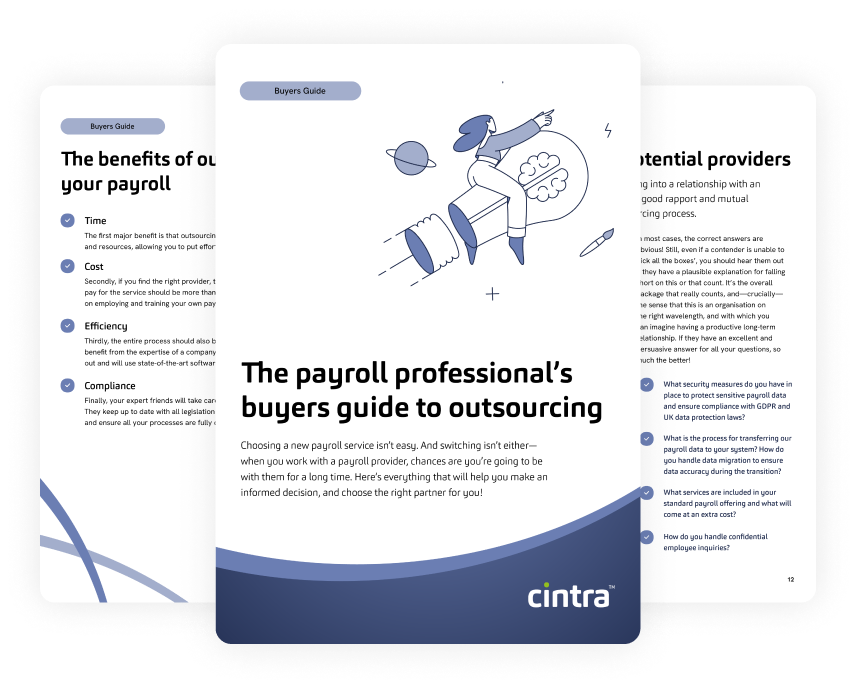
Payroll Outsourcing Buyers Guide
Download everything you need to know in your payroll outsourcing buyers journey—covering services and solutions in depth.
Download your buyers guide
